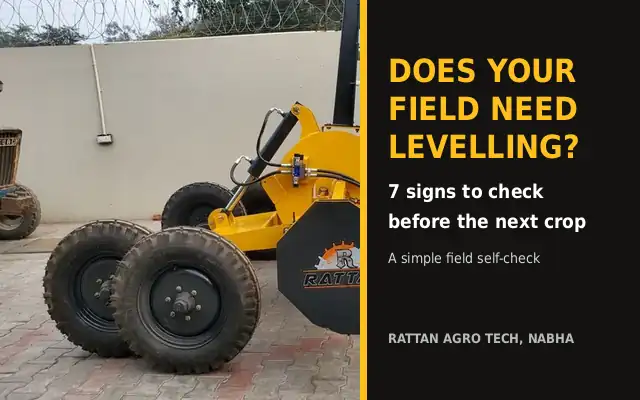
Most farmers know laser levelling is good for a field. The harder question is: does my field need it right now? You do not need any equipment to get a first answer. Your field already shows you the signs, at every irrigation and every sowing. This article lists seven of them, gives you a simple test to do at your next irrigation, and a quick score to decide what to do next.
New to laser levelling? Start with our laser land leveller guide.
7 signs your field needs laser levelling
Tick each one that matches your field. Keep count; you will need it for the score further down.
The irrigation walk test
Signs 1 and 2 are easy to check properly. At your next irrigation, try this:
- On paper, draw your field as a simple box and divide it into a grid of squares.
- Once water has entered the field, walk across it at the same time each irrigation, for example one hour after you start.
- In each square, mark W if water is standing, D if it is still dry, and OK if it is evenly wet.
- Keep the sheet. Do the same at the next irrigation and compare.
If W and D squares keep showing up in the same places irrigation after irrigation, the field has a level problem, not just a one-off watering issue.
Your score: what to do next
This score is a rough guide, not a measurement. Some of these signs can also come from soil, drainage or other causes. A laser survey gives you the real picture, and for crop-related questions your local PAU or agriculture department experts are a good source.
How a laser survey confirms it
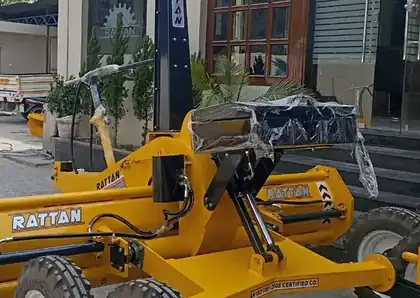
Your walk test tells you where the problem is. A laser survey tells you how big it is. The transmitter is set up at the field edge, and readings are taken at points across the field with the receiver. These readings show exactly how high or low each spot is, and how much soil needs to be cut and filled. Our Laser Levelling Day walkthrough explains the survey and the levelling step by step, and the Alpha Pro Shot article explains the transmitter, receiver and control box.
Frequently asked questions
My field looks flat. Can it still be uneven?
Yes. Small differences in height are hard to see by eye but show up clearly in how water spreads. That is why the irrigation walk test is more reliable than looking at the field.
Is laser levelling only useful for paddy?
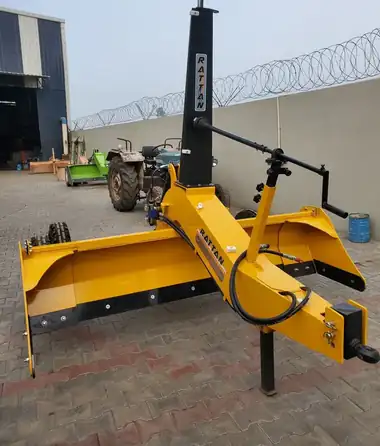
No. Any crop that is irrigated by flooding the field benefits when water spreads evenly, including wheat. Rattan levellers work on clay, loam, sandy and black cotton soils.
I levelled my field a few years ago. Do I need to do it again?
Not always. Do the walk test first. If the signs are coming back, a laser check will show whether a light touch-up is enough.
What tractor do I need for a laser leveller?
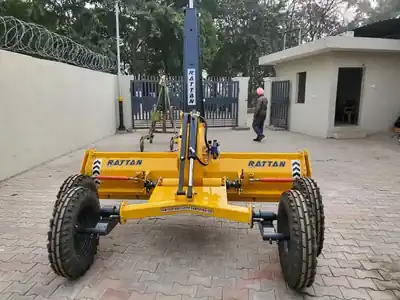
A tractor of 50 HP or more, of any brand. The Rattan leveller fits the standard drawbar hitch and comes with the Alpha Pro Shot laser kit.
More on laser levelling: Complete guide · Levelling day walkthrough · Alpha Pro Shot laser system
Scored 2 or more?
Tell us your tractor HP, field size and soil type, and we will help you plan the right machine. ਤੁਸੀਂ ਸਾਡੇ ਨਾਲ ਪੰਜਾਬੀ ਵਿੱਚ ਵੀ ਗੱਲ ਕਰ ਸਕਦੇ ਹੋ।