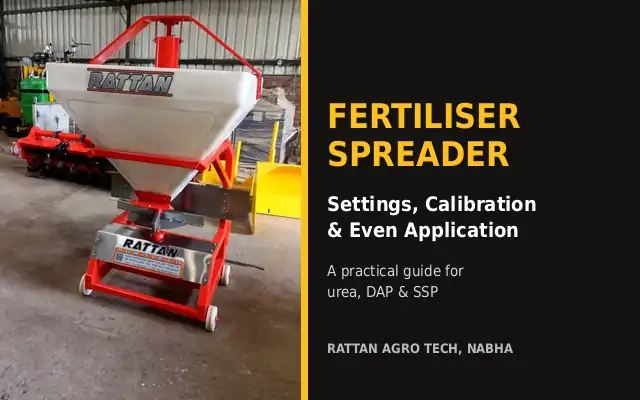
Spreading fertiliser by hand is slow, tiring and uneven. One part of the field gets too much, another gets too little, and the crop shows it later as patches of dark green and yellow. A tractor-mounted fertiliser spreader fixes this. It broadcasts granular fertiliser evenly across the field in a fraction of the time, so every plant gets its share.
This guide explains how a fertiliser spreader works, how to set the rate and spread width, how to calibrate it, and the habits that keep it working season after season.
How a fertiliser spreader works
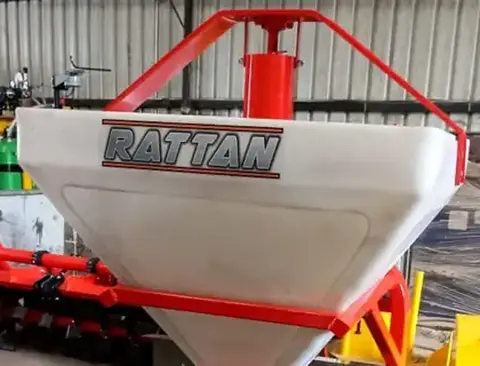
The Rattan Fertiliser Spreader is a hopper-fed broadcast spreader. It works in three simple steps:
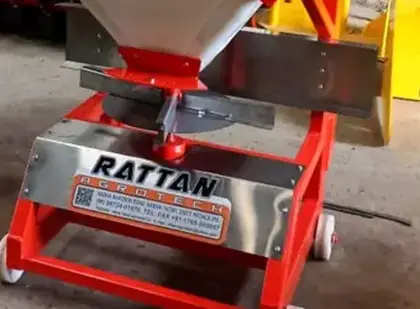
Before you start: check the machine
- Hopper: make sure it is clean and dry inside, with no old caked fertiliser.
- Gate: open and close it by hand and check it moves freely and shuts fully.
- Spinner plate and vanes: check for bends, cracks or heavy wear. A bent vane throws fertiliser unevenly.
- PTO shaft: grease the joints and make sure the guard is in place.
- Mounting: fit the spreader level on the three-point linkage. A tilted spreader throws more to one side.
Setting the rate and spread width
The Rattan spreader has an adjustable spread width and rate. Two things decide how much fertiliser lands on each acre:
- Gate opening: a wider opening lets more fertiliser out.
- Tractor speed: at the same gate setting, driving faster puts less fertiliser on each acre, and driving slower puts more.
Different fertilisers also flow differently. Urea, DAP and SSP have different granule sizes and weights, so the same gate setting will not give the same rate for all three. Set the machine separately for each fertiliser you use.
- Weigh a known amount of fertiliser, say one bag, and put it in the hopper.
- Pick a gate setting and a tractor gear, and keep the engine speed steady.
- Spread over a measured strip of the field, for example a set length at your spread width.
- Weigh what is left in the hopper. The difference is what went on the strip.
- Work out the rate per acre from the strip’s area, and adjust the gate or speed until it matches your target.
- Write down the gate setting and gear that worked for each fertiliser, so next time you can start from there.
How much fertiliser should you apply? That depends on the crop, the growth stage and your soil. A soil test is the best guide. Follow the current recommendations from Punjab Agricultural University (PAU) or your local agriculture department, and split doses the way they advise.
Tips for even spreading in the field
- Keep a steady speed. Every change in speed changes the rate.
- Engage the PTO before opening the gate, and close the gate before stopping or turning, so fertiliser does not pile up in one spot.
- Overlap the passes correctly. A broadcast pattern is thicker in the middle and thinner at the edges, so passes need a little overlap to even it out. Use a marker or fixed points on the field edge to keep your lines.
- Avoid windy days. Wind carries the finer granules away and spoils the pattern.
- Watch the hopper. Refill before it runs empty so the flow stays even.
- Spread headlands separately, so the field edges are not missed or doubled.
Care and maintenance
Fertilisers draw moisture from the air and are corrosive to steel. Most spreader problems come from fertiliser left sitting inside the machine.
- Empty the hopper completely
- Wash the hopper, gate and spinner with water
- Let it dry fully
- Grease the PTO joints
- Clean thoroughly and dry
- Oil the metal parts against rust
- Check the spinner vanes and gate
- Store under a roof, off the ground
Common mistakes to avoid
Safety
Wear gloves when handling fertiliser and wash your hands afterwards. Never reach near the spinner plate or PTO shaft while the PTO is running, and keep children and animals away from the machine during work.
Get a fertiliser spreader from Rattan Agro Tech
Rattan Agro Tech builds fertiliser spreaders at our ISO 9001:2008 certified factory in Nabha, Punjab, alongside our laser land levellers, super seeders, rotavators and spray pumps. If you want a price, help choosing the right model, or advice on setting up your spreader, our team is happy to help.
Interested in a Fertiliser Spreader?
Ask for the price and specifications. You can talk to us in Punjabi or Hindi too. ਤੁਸੀਂ ਸਾਡੇ ਨਾਲ ਪੰਜਾਬੀ ਵਿੱਚ ਵੀ ਗੱਲ ਕਰ ਸਕਦੇ ਹੋ।